Writing Reference
What is a character bible?
The definition, a template with every field you might need, and the part nobody covers: how to build one from a draft you already have instead of starting from scratch.
Last updated: September 2026
The short answer
A character bible is the reference for every person in your story: who they are, who they know, and how they change across the book. It sits alongside the manuscript rather than inside it, and its job is to answer a question about a character at the moment you need the answer rather than three chapters after you needed it.
Character bible, story bible, and the relationship between them
A character bible is the character-only section of a story bible. The story bible holds everything you invented, including places, timelines, plot threads, and rules. The character bible is the part of it that covers the people. Some writers keep their character material separately because it grows faster than the rest, and that is a filing decision rather than a different kind of document.
What goes wrong without one
A name is the first thing to go. You give a minor character brown eyes in chapter four and hazel in chapter twenty-two, five months apart, and both feel right because both came from your own imagination. A copyeditor catches it, or a reader does, and either way the fix is a trip through the entire manuscript wondering which one you meant.
Relationships go next. Two characters who met in a flashback that you cut before publication still reference that meeting in chapter sixteen. A character who was established as an only child gains a sister somewhere around act three because you forgot, and you do not catch it because neither fact is wrong on its own. A sidekick who appeared in four early chapters disappears for a hundred pages and returns without anyone remarking on the absence, because you lost track of where they were.
The deeper the cast, the faster these stack up.
A character bible does not prevent mistakes. It makes the answer findable before the mistake lands on the page.
The character bible template
Here is every field you might need for one character, with what it holds and the question it answers. Not all of them will apply to your book. Copy the ones that do; leave the rest.
← Scroll to see the full table →
| Field | What it holds | The question it answers |
|---|---|---|
| Full name and aliases | Every name, nickname, and title they go by | What do other characters call them? |
| Role | Protagonist, antagonist, supporting, minor | How much page time does this person earn? |
| Age and occupation | How old they are (or how old they look), what they do | How old is this person, and what do they do for a living? |
| Physical appearance | Height, build, hair, eyes, distinguishing marks | What did I already say they look like? |
| Personality and voice | Mannerisms, speech patterns, temperament | How does this person talk, and what do they do when they are nervous? |
| Backstory | What happened before the book opens | Why are they the way they are? |
| Goals and motivations | What they want, why they want it, what they will do to get it | What is driving this character right now? |
| Internal arc | How the character changes from the start to the end | Where are they in their own story right now? |
| Relationships | Who they know, what each person calls the other, which direction the bond runs | Have these two met, and what happened when they did? |
| Affiliations | Factions, families, guilds, employers | Where does this person's loyalty sit? |
| Possessions | Objects they carry, inherit, or lose | Who had this last? |
| Chapter appearances | A list of which chapters or scenes they show up in | Where have I put this person, and where have I not? |
| Timeline | Events involving this character, in order | What has happened to them so far? |
| Notes | Anything that does not fit the categories above | What else did I decide about them? |
Three guidelines on the list. First, write the appearance and personality entries in the same tense you use in the manuscript, because you will copy from one to the other and a tense mismatch is a tell. Second, the chapter-appearances row is the one most writers skip and most wish they had kept: it is the only way to know, at a glance, that a character vanished for a stretch and nobody in the story noticed. Third, start with fewer fields and add them when a question comes up that the entry cannot answer. An empty template is not a character bible; a short, current entry is.
How many characters to cover
Every named character who appears more than once, plus any character whose backstory or appearance you have decided even if they have only one scene.
A character bible that covers only the leads misses exactly the characters whose details are hardest to remember: the minor ones who show up in chapter four and again in chapter thirty. You know your protagonist's eye color because you think about them every day. The innkeeper from the second town is the one you need to look up.
Building one from a draft you already have
Most guides assume you start a character bible before you write the book. Most writers do not. The draft exists, the cast is in it, and the question is how to get the details out of the prose and into a reference you can actually use. The manual way is to read the draft, chapter by chapter, and write down every character detail you stated. It works. It is also the kind of task that takes a weekend and never gets scheduled, which is why most character bibles that start this way stop at chapter six.
The faster path is to let the text tell you who is in it. Import the manuscript, scan a chapter, and the people, places, and things in the prose come back as proposed entries you review and keep or dismiss. That is what Penpoint's Chapter Scanner does.
How Penpoint does it
Penpoint is a desktop writing app where every character is an entry with a sheet you design yourself. You build the sheet once in Character Sheet Setup: choose from blocks like text, traits, numbers, images, relationships, linked items and locations, chapter appearances, and a character arc that visualizes how their fortune changes across the story. Every character in the book then gets those fields, and each one fills them in differently.
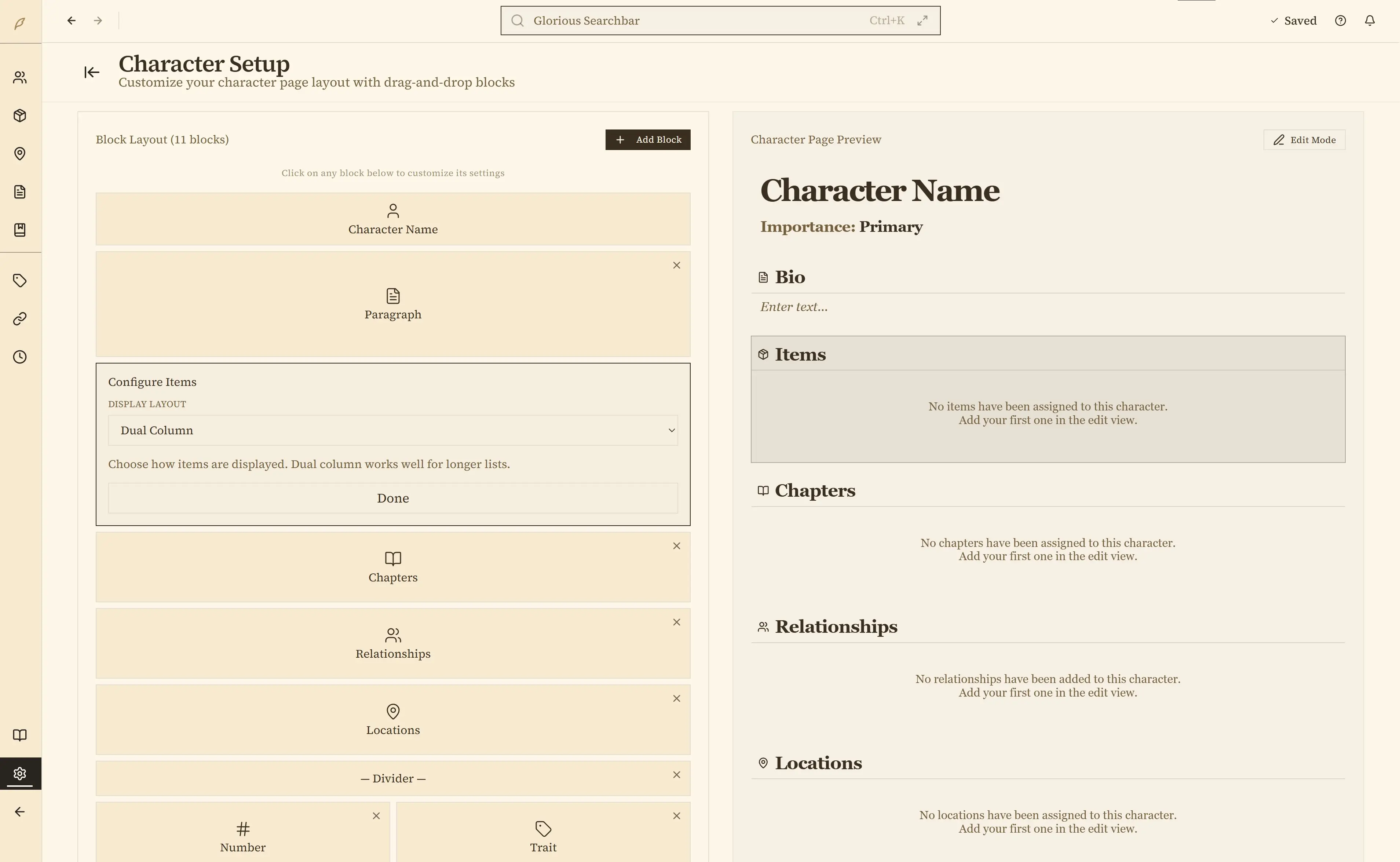
Traits are dropdown or freeform. A dropdown trait like "Alignment" shares its options across the whole cast, so you can filter your characters by it later. A freeform trait like "Quirk" is just text. You make as many of each as you need.
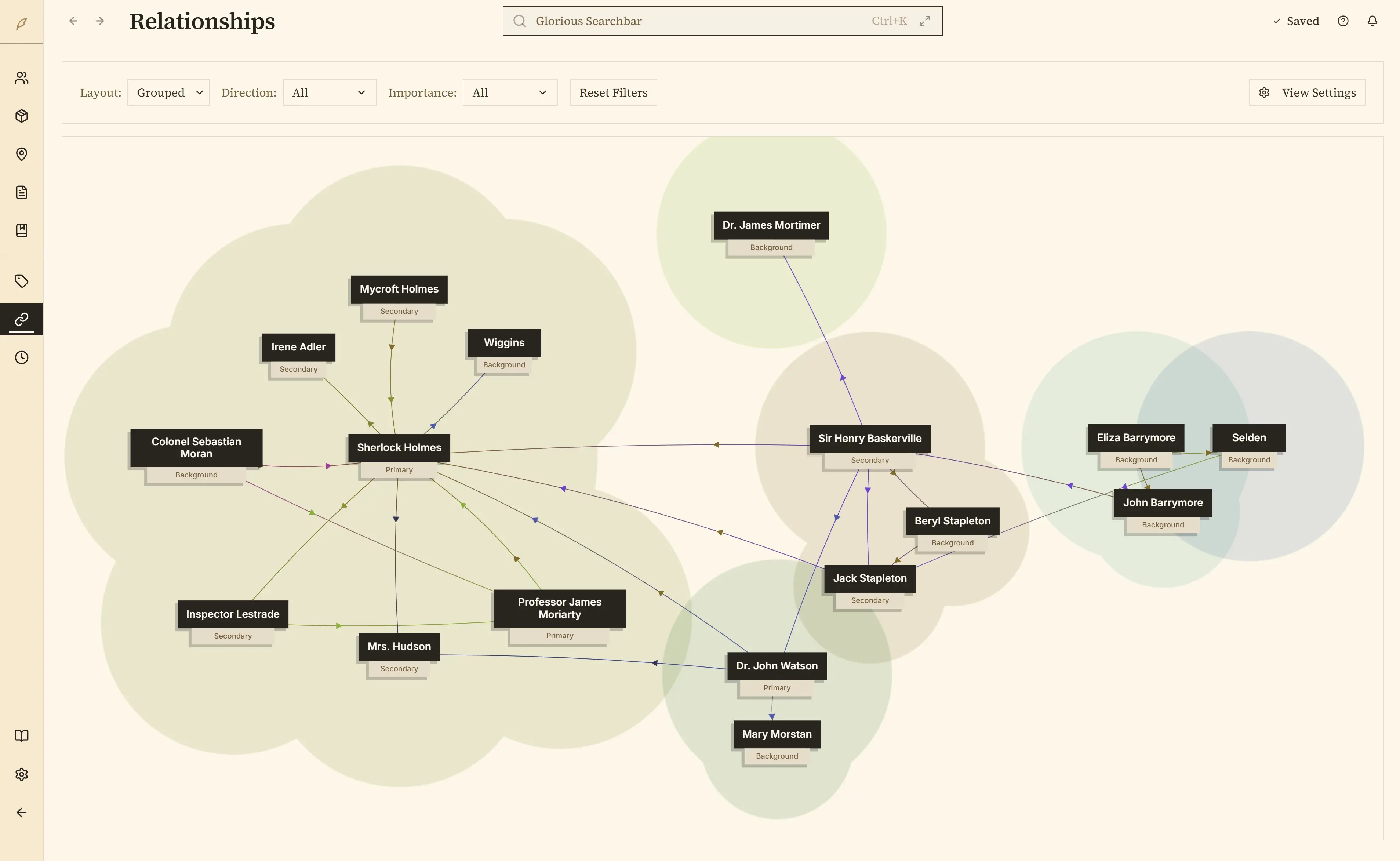
Relationships connect two characters with a label you write yourself: "Father" on one side, "Son" on the other, or anything else, because the vocabulary is yours rather than a fixed list. Penpoint can create both directions in one step, and the Relationship Map draws the whole cast as a web of connections, grouped by who is linked to whom, filterable by importance.
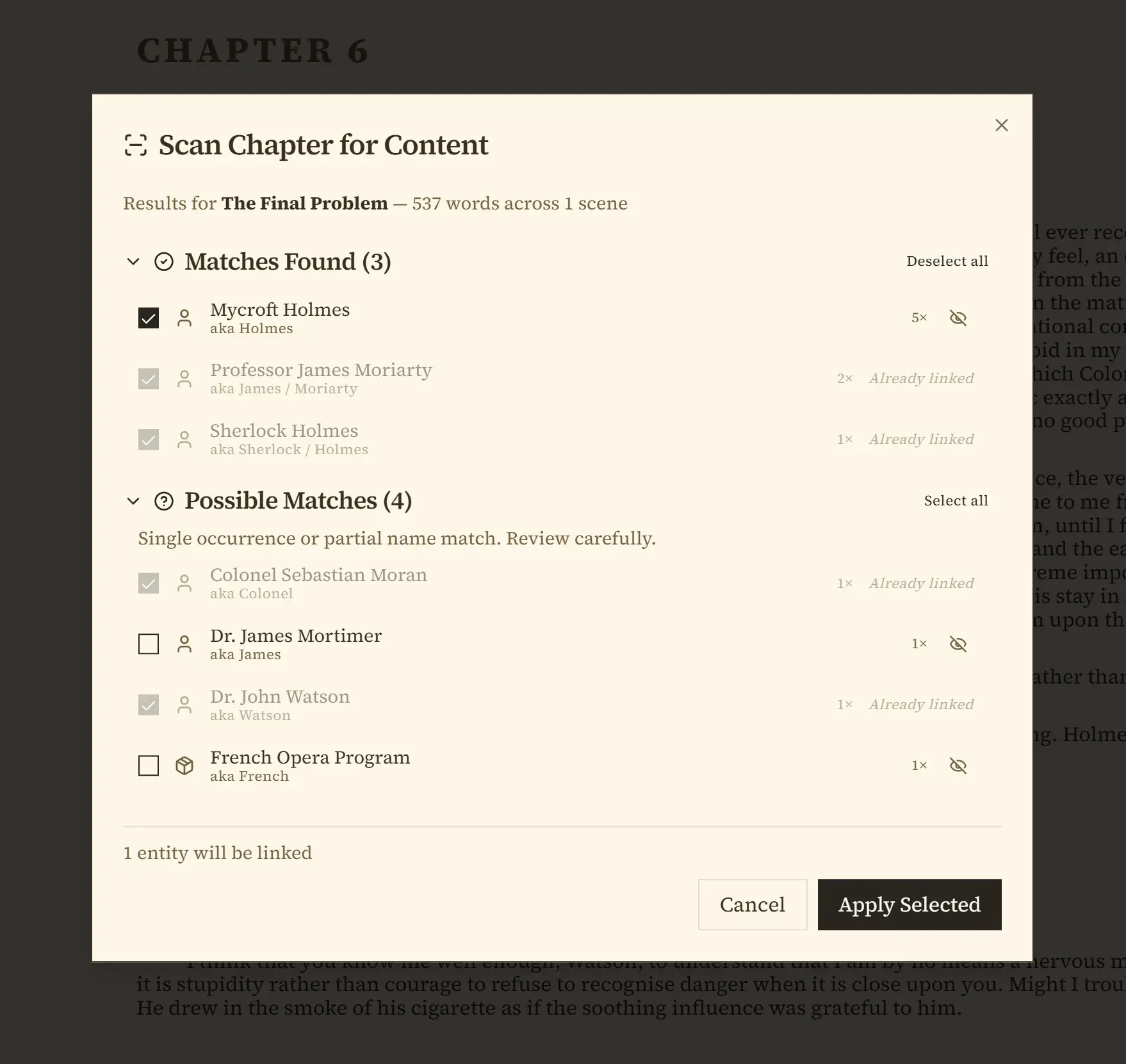
For a draft that already exists, the Chapter Scanner reads a chapter and proposes the characters it finds, sorted into Matches Found, Possible Matches, and New Discoveries. It works by reading how a name is used in a sentence rather than only noticing that it is capitalized, so it catches locations and items too. Nothing is written until you review the list and apply what you want. Import a finished manuscript and you can have a filled-in character bible the same afternoon.
When one book becomes several, converting to a Series keeps one shared cast across every installment. A character written in Book 1 is the same entry in Book 3, and editing their sheet updates it everywhere. A This Book / All Books toggle narrows the app to one installment or opens it to the full saga, and per-book Presence controls which characters appear on each book's list without deleting them from the series.
Typing @ in any text field drops a live link to a character, and renaming that character updates every mention everywhere with no find-and-replace step.
What Penpoint does not do
The Relationship Map is characters only. Items and locations link to characters as data on the character's sheet, but they do not appear as nodes on the map. If you need a full web of every kind of thing connected to every other kind, Penpoint is not there yet.
Traits are text or dropdown. There is no numeric slider, no date field, and no way to score one option higher than another. A numeric stat lives in a Number block instead of a Trait, which works but means it cannot appear in the same column as your text traits. Relationship labels are free text with autocomplete, and nothing enforces that "Father" on one side and "Son" on the other agree or that they exist at all. The Reciprocal filter on the map shows which pairs do point both ways, but it does not enforce anything.
Character bible questions, answered
What is a character bible?
A character bible is the reference for every person in your story: who they are, who they know, and how they change across the book. It sits alongside the manuscript rather than inside it, and its job is to answer a question about a character at the moment you need the answer rather than three chapters after you needed it.
What is the difference between a character bible and a story bible?
A story bible covers your whole invented world: places, timelines, plot threads, rules. A character bible narrows that to the people. The two are the same kind of document at different scopes, and some writers split them because the character section outgrows the rest.
What should a character bible include?
A character bible should include, at minimum: name and aliases, role in the story, physical appearance, personality and voice, backstory, goals and motivations, relationships to other characters, and a list of which chapters or scenes the character appears in. Many writers also track internal arc, affiliations, possessions, and a timeline of events the character is involved in.
How do you keep a character bible from going stale?
A character bible stays current when you write in it at the moment you invent the detail, not afterward. Wait even one scene and you will not remember whether you decided the fact or are only assuming it now. Update the entry while you are still writing the scene that needed it, because that is the only point where you are certain of it. If the character bible lives in a separate document from the manuscript, every update means stopping to go open it, and that stop is the first thing skipped once the scene is going well.
How many characters should a character bible cover?
A character bible should cover every named character who shows up more than once, plus anyone whose appearance or backstory you have decided, even if they have a single scene. The leads are not the problem: you think about your protagonist every day. The innkeeper from the second town, five months after you wrote that chapter, is the one you will need to look up.
Does Penpoint have a character bible?
Penpoint is built around one. Every character is an entry with a sheet you design yourself from blocks: text, traits, numbers, images, relationships, items, locations, chapters, and a character arc. The Chapter Scanner reads a chapter you already wrote and proposes the characters it finds. In a Series, one character entry stays current across every book. Penpoint costs $40 once and runs on Windows, macOS, and Linux.
Your characters and your manuscript, in one file.
Every feature for 14 days, with no account and no card. $40 once after that, for Windows, macOS, and Linux together.
Join our Discord