Writing Reference
What is a story bible?
The definition, what belongs in one, a template you can copy, and the part nobody explains: how to keep it current once the draft is moving.
Last updated: September 2026
The short answer
A story bible is the reference document for everything you invented: your cast, your places, your objects, your timeline, and the rules your world runs on. It is not part of the manuscript and no reader ever sees it. Its one job is to answer a question you cannot remember the answer to at the moment you need it.
Story bible, series bible, world bible, character bible
These names get used for the same document, and the differences that do exist are about scope rather than kind.
A series bible is a story bible that covers more than one book. A world bible is the same document named after its largest section. A show bible is the television version, and it carries material a novelist has no use for, because part of its job is pitching the series to people who have not read it. A character bible is the character-only slice: the same document, narrowed to the people. We wrote a separate page on character bibles because that section grows faster than the rest and has its own field list.
Use whichever word you like; what goes in it is the same either way.
What goes wrong without one
The case for a story bible is usually made in the abstract, as organization or professionalism. The real case is narrower and easier to recognize, because it has happened to everyone who has written a long book.
You are four months into a draft. In chapter three the innkeeper was Marta. In chapter nineteen, written in a different season of your life, she is Marla. Neither spelling looks wrong, because both of them came out of your own head. A reader catches it, or a copyeditor does, and either way you now go back through a hundred thousand words deciding which one she was.
The same failure has other shapes. A character who was introduced with green eyes and finishes the book with brown ones. A journey that takes six days going and two days coming back, with no explanation in the text. A sword you established as lost in chapter eight, held by someone in chapter twenty. A character who disappears for nine chapters and returns as though they never left.
None of these are failures of talent. They are failures of recall across a document too long to hold in your head, written over a period too long to remember clearly.
That is what the story bible is for. Not tidiness. Recall.
The story bible template
Copy it into whatever you already use. Nothing here is specific to any one tool.
← Scroll to see the full table →
| Section | What it holds | The question it answers |
|---|---|---|
| Characters | Name, aliases, role in the story, appearance, voice, history, wants | Who is this, and what did I already decide about them? |
| Relationships | Who knows whom, and what each one calls the other | Have these two met yet, and what happened when they did? |
| Locations | Places, what they look like, and which larger place contains them | Where is this, and what is it inside of? |
| Items | Objects that matter, who owns them, where they are now | Who had this last, and where did they leave it? |
| Timeline | Events in order, dated where dates exist | How long ago was that, and what else was happening? |
| Calendar | Your months, seasons, eras, and how dates are written | What is today called, in the world of the book? |
| Plot threads | Each storyline, its beats, and where each beat lands | Is this thread still running, and where did I leave it? |
| Character arcs | How each person changes, and at which points | Where is this character in their own story right now? |
| Rules | Magic, technology, politics, economics, and their costs and limits | Can they do this, and what does it cost them? |
| Languages and names | Invented words, naming conventions, spellings you settled on | How do I spell that, and does it follow my own rules? |
| Chapter summaries | One or two lines per chapter, plus who appears in it | Which chapter was that in? |
| Open questions | Decisions you deliberately have not made yet | Did I ever settle this? |
You will not fill all twelve, and a bible with four live sections beats one with twelve empty headings. The last row earns its place: writing down what you have not decided stops you from quietly deciding it twice.
Keeping it current, which is the hard part
Almost every guide to story bibles stops at the list of sections. That list is the easy half. The reason most story bibles fail is that they are written once, at the start, and then fall behind the draft until they are actively misleading.
A bible that disagrees with your manuscript is worse than no bible, because you will trust it.
Three habits keep it alive. Update it when you invent something, not later, because the gap between inventing and recording is where facts get lost. Record what is true in the draft rather than what you intended, since the draft is what the reader gets. And write the entry for something the moment it acquires a second detail, because one detail you can hold in your head and two you cannot.
The structural problem underneath all three is that most story bibles live somewhere other than the manuscript. A separate document, a separate app, a folder of notes. Every update means stopping the scene to go and write somewhere else, and that is exactly what gets skipped at eleven at night when the scene is finally working.
How Penpoint does it
Penpoint is a desktop writing app built around a story bible rather than beside one. The manuscript and the reference material live in the same file, and the reference material is made of entries the app can read rather than pages of prose it cannot.
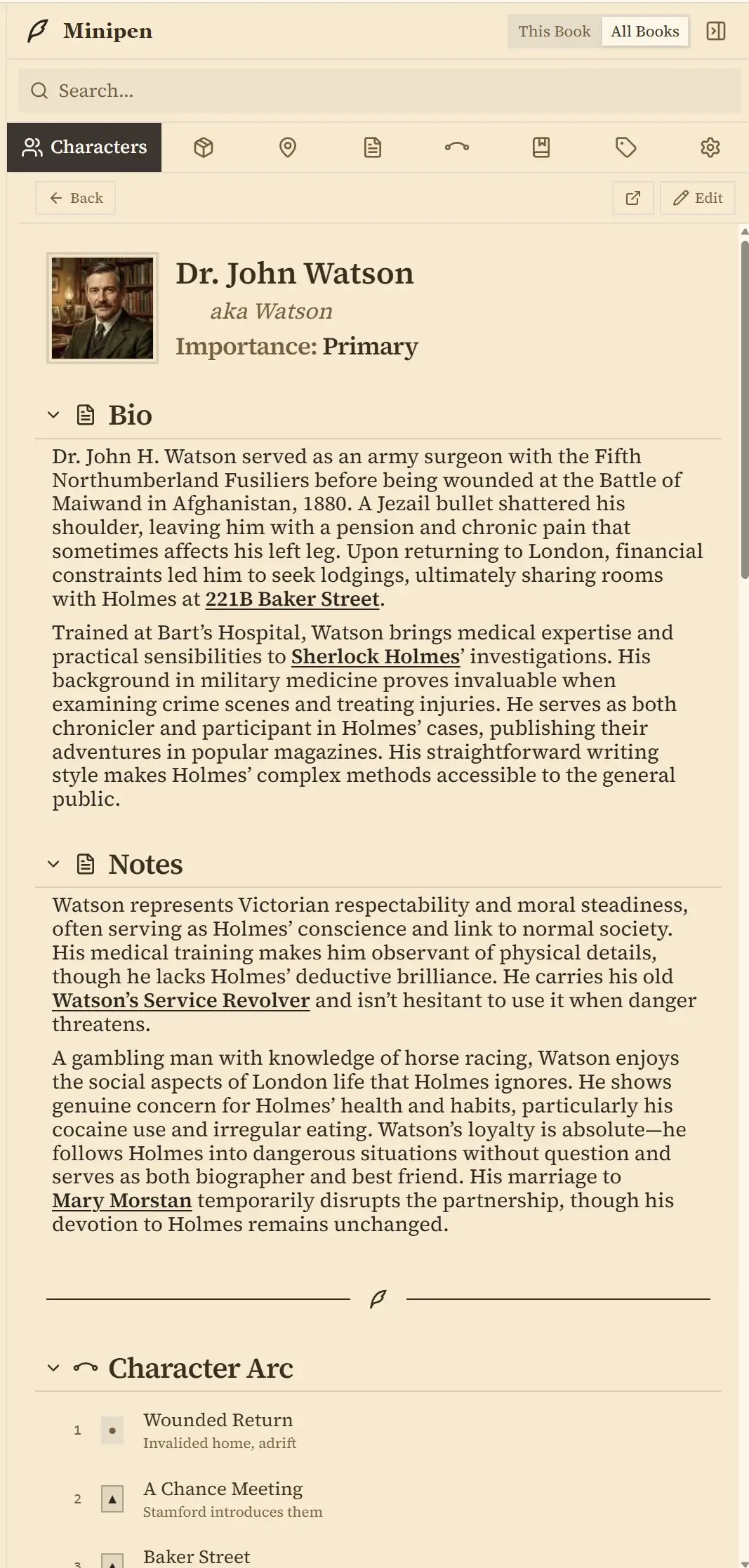
Characters, locations, and items are entries. Locations sit inside other locations to whatever depth your world needs, so a cellar belongs to a tavern, which belongs to a city, which belongs to a kingdom. An item knows who owns it and where it first appeared. Events are entries of their own that several characters, places, and objects can all attach to at once, and an event can carry a date from a custom calendar with your own months and eras, or a simple day count, or ordinary Gregorian dates.
The character sheet is not a fixed form. You build it once in Character Sheet Setup, choosing which traits, tags, numbers, images, relationships, linked items and locations, and arcs each character carries. Every character in the book then has those same fields, and each one fills them in differently.
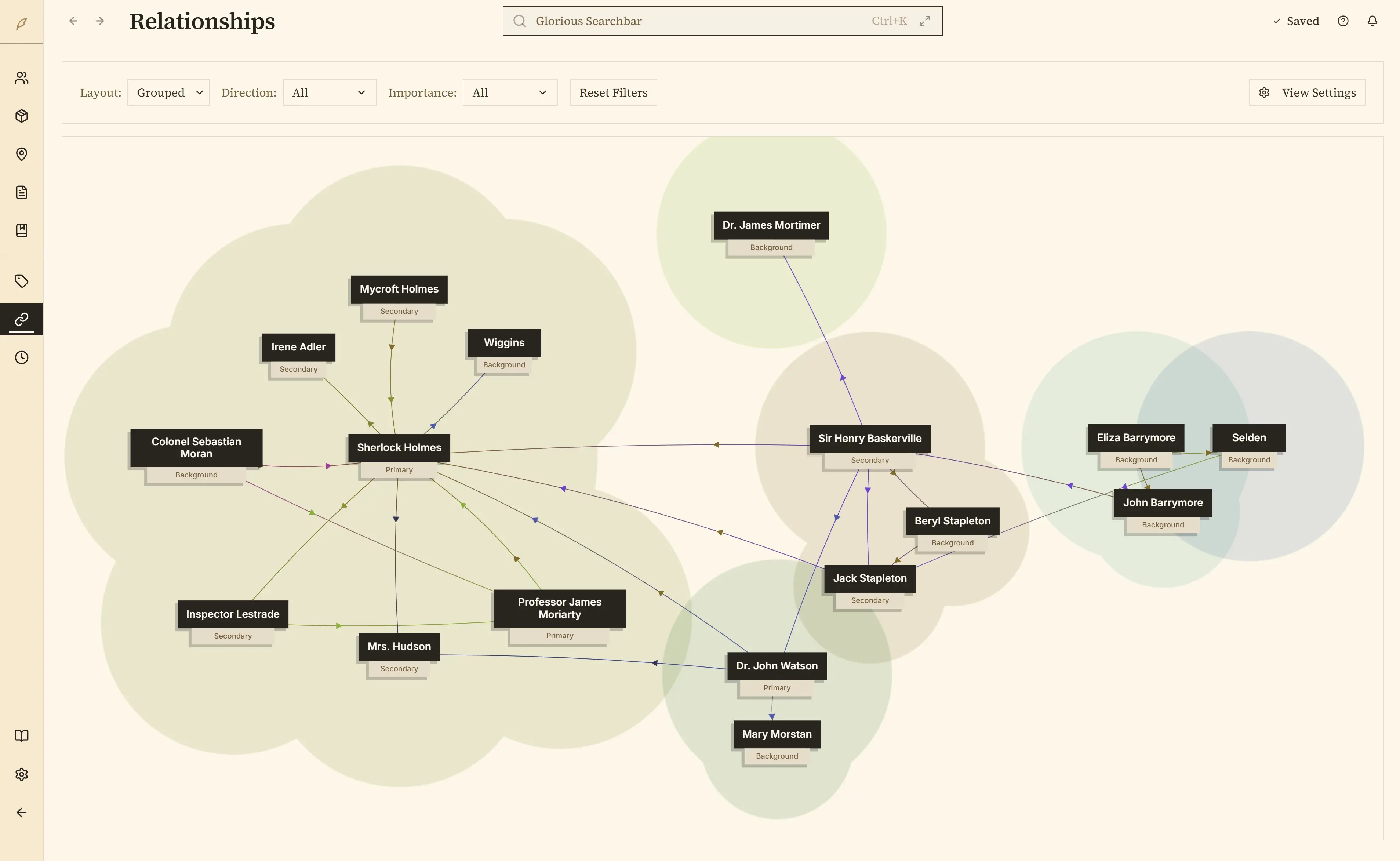
The links are what separate this from a folder of documents. Typing @ anywhere in your worldbuilding drops a live link to a character, place, item, chapter, scene, note, or arc. Those links store the thing itself rather than its name, so renaming a character updates every mention of them everywhere, with no find-and-replace step. The Relationship Map draws your cast as a web of connections, gathers the people who are linked to each other into groups, and can filter down to only the relationships both people acknowledge.
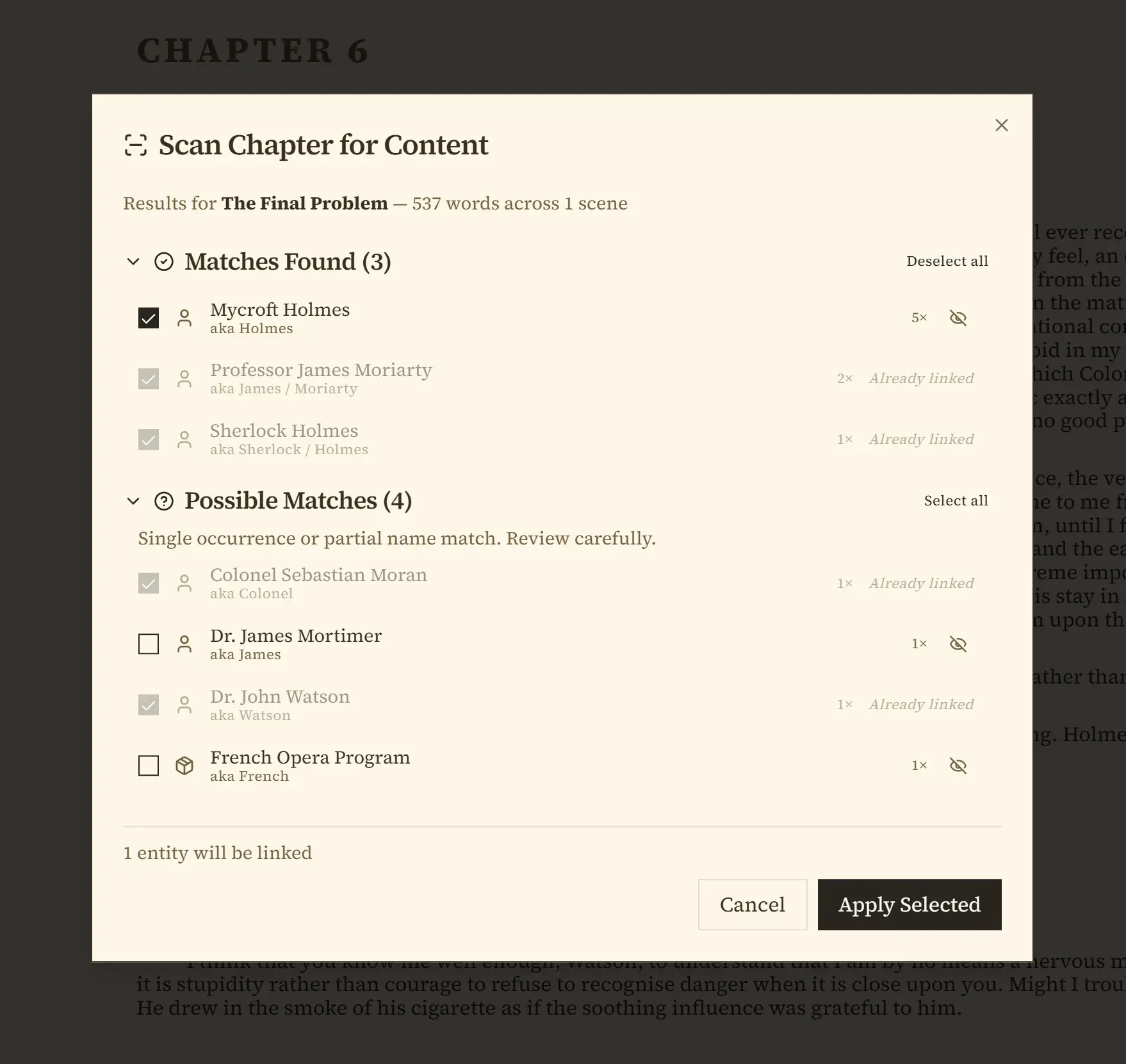
For a draft that already exists, the Chapter Scanner reads a chapter you have written and proposes the worldbuilding entries it finds in the prose, sorted into Matches Found, Possible Matches, and New Discoveries. It works by reading how a name is used in a sentence rather than only noticing that it is capitalized. It runs entirely on your machine with no model to download, because Penpoint does not use generative AI anywhere. Nothing is written until you review the list and apply it.
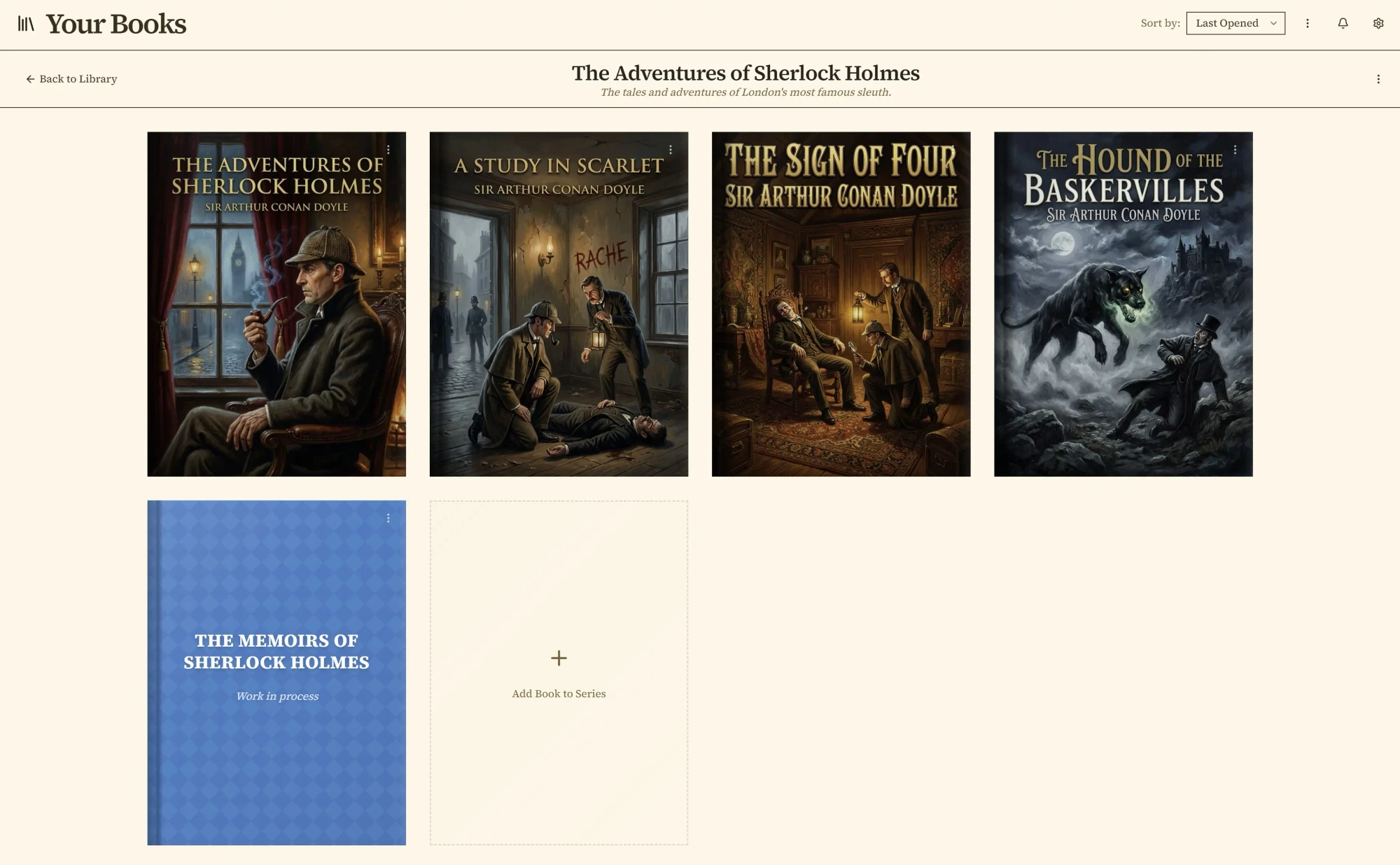
When one book becomes several, converting to a Series keeps one shared cast and world across every installment while each book keeps its own chapters and plot threads. A character written once stays current in every book, and a This Book / All Books toggle narrows the whole app to the installment you are drafting or opens it back up to the whole saga. Your story bible comes back out as a document whenever you want it: the Compendium exports to Markdown (a plain-text format any editor can open) in one click, and the Export Wizard takes characters, locations, items, notes, chapters, and arcs to Word, PDF, RTF, plain text, or Markdown, as one combined file or one file per entry.
What Penpoint does not do
There is no interactive map. Locations nest and carry an image, but you cannot pin them to a drawing of your world and click around it. There is no family-tree chart either; the Relationship Map is a general web with labels you write yourself, which suits a cast better than it suits a dynasty.
Custom fields cover characters and chapters but not items or locations, so you cannot add a "climate" field to a location the way you can add anything you like to a character sheet. And while events are entries in their own right, there is no single master timeline page that lists every event in the book; you see them from the characters, places, and chapters they belong to.
If a pinnable world map is the reason you are looking, a wiki-style tool will serve you better than we will. Our six-way comparison table lays out who does what.
Story bible questions, answered
What is a story bible?
A story bible is the reference document for everything you invented: your cast, your places, your objects, your timeline, and the rules your world runs on. It is not part of the manuscript and no reader ever sees it. Its one job is to answer a question you cannot remember the answer to at the moment you need it.
What is the difference between a story bible and a series bible?
A series bible is a story bible that covers more than one book. The contents are the same: cast, places, timeline, rules. What changes is scope, because a fact in a series bible has to stay true across every installment rather than just the one you are drafting. Writers also use the terms world bible and show bible for the same document, with show bible carrying a television sense that includes pitching material.
What is the difference between a story bible and a character bible?
A character bible is the character-only slice of a story bible. The story bible holds everything you invented, and the character bible is the part of it that describes the people: who they are, who they know, and how they change. Some writers keep the character material separately because it grows faster than the rest, and that is a filing decision rather than a different kind of document.
When should you start a story bible?
Start a story bible the first time you have to scroll back through your own draft to check a detail you already decided. That moment is the signal, and it usually arrives earlier than writers expect. Starting late is normal and recoverable, because the facts are already in the manuscript and the work is transcribing them rather than inventing them again.
Do I need a story bible for a standalone novel?
A standalone novel needs a story bible less than a series does, but the threshold is lower than it sounds. A book with a dozen named characters, a handful of locations, and events that happened before chapter one is already past the point where memory is reliable, especially across a draft written over many months.
Can a story bible just be a document?
A story bible can be a plain document, and many working writers keep one that way. The limit of a document is that it can hold a fact but cannot answer a question about it: a page of prose cannot tell you which chapters a character appears in, or which of your people have met, because as far as the file is concerned it is all just words.
Does Penpoint have a story bible?
Penpoint is built around one. Characters, locations, items, events, arcs, and tags are entries rather than pages of prose, they link to each other and to the chapters they appear in, and the Chapter Scanner reads a chapter you already wrote and proposes the entries it finds. Penpoint costs $40 once, runs on Windows, macOS, and Linux, and keeps your book as a file on your own disk.
Your manuscript and your story bible, in one file.
Every feature for 14 days, with no account and no card. $40 once after that, for Windows, macOS, and Linux together.
Join our Discord